

This is part 1 of 3 in a series on kids and social media. See below for links to other articles.
Imagine driving down a country road late at night. Quiet outside, favourite track playing, you are calm and alert, enjoying the ride. And here it comes. In the distance you see a green traffic light in the middle of nowhere. You get closer. It turns yellow, then red. You swear at whoever put it there. But you stop. What are you thinking? I know. You have seen no person or car in the past 5km. It is 3am — the police are asleep. Should I run the light? You don’t. Most of us won’t. Why? Because it feels wrong. A few would still do it for the same exact reason.
You sit alone in the dark, obeying a coloured bulb, because you believe what it stands for: everyone gets home alive when we take our turn.
At noon on the same road, you’ll do 15 over the limit with everybody else, slowing only for a cruiser silhouette on the shoulder.
Same driver, same road. Conscience vs radar. The psychologist Tom Tyler spent a career documenting this in his book Why People Obey the Law.
Many countries and states, including Canada, are debating social media bans for children under 16.
Will it work?
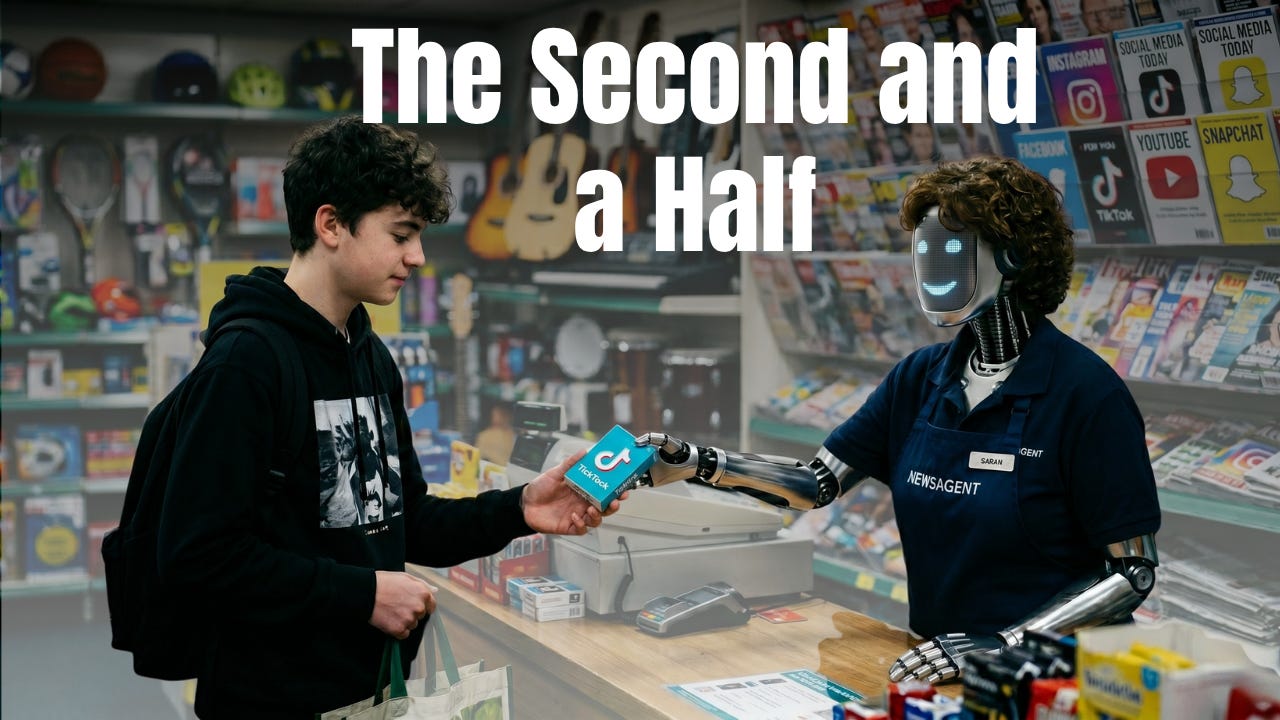
Watch a 15-year-old try to buy cigarettes. The clerk looks at him for a second and a half, asks for ID, shrugs, turns to the next customer. No inspector watching. What stopped the sale? One tired woman decided she would not be the one to sell smokes to somebody’s kid.
That second and a half is the entire system.
The clerk believes smoking is bad for children. She wouldn’t want her kid to buy smokes from another store, so she plays her part, just like the clerk next door. The same goes for alcohol. The system works.
Why didn’t Prohibition work? Because neither the barkeep in the speakeasy nor the customers believed it was wrong to serve the booze. That law lasted 13 years. Then it fell.
The social media ban expects corporations to develop a conscience. It expects a soulless firm to feel bad handing access to the kids.
The ban advocates miss one crucial point: drinks and cigarettes are physical objects.
The clerk picks up the pack. Feels the plastic wrap, the sharp corners, the weight of it in her palm. She knows one of those cigarettes may kill the kid. She is about to place it in his hand. Her arm has to extend. Her fingers have to release. It is different from clicking the “Allow” button.
Stabbing someone requires presence, resistance, eye contact. The body feels what you are doing, and to whom, before the mind catches up. Enough to stop her arm.
Now put the same child in front of a platform’s age verification. No pack, no plastic, no weight, no arm extending across a counter. Approved. The platform is a drone operator — the target is real, but the hands stay clean.
There is no shortage of believers. Three-quarters of Canadians support the ban. Nearly two-thirds of Americans back it. Teachers, pediatricians, exhausted parents. Every day parents ask me for help with their kids’ devices. Who is supposed to stop them? As a father and psychiatrist, I have asked myself the same question.
The army is ready. The enemy is clear. What is missing is a battlefield. There is no ground to stand on. No counter. No material object.
It is like fighting a virus with a bazooka.
The source of the virus is the platform. The irony is that it gets paid by the violation itself. Admit a bunch of 14-year-olds: risk a fine — up to A$49.5 million in Australia, a small price to pay to acquire lifetime customers at the age when habits set deepest. The fine is priced against quarterly profit. The child is priced against a lifetime.
No shop clerk ever faced that arithmetic; protecting the business and protecting the child pointed in the same direction.
Legal scholars call it gatekeeper liability, mapped by Reinier Kraakman in 1986. John Coffee documented the pattern: gatekeepers fold when they are paid by the people they police. The auditor’s customer was the company it audited.
Australia caught it in the act. Three months into its ban, the eSafety Commissioner reported that platforms were letting children retake the age check, again and again, to ultimately obtain a 16+ outcome. It is as if a clerk let a kid keep flashing IDs until one worked.
Australia has made the bootlegger the bartender.
The Australian Prime Minister declared: “This is working!” one month into the pioneering social media ban. 4.7 million underage accounts across all platforms were deactivated.
Six months in, an independent survey found that out of about 4.8 mln kids, 78 per cent of under-16s were still on the banned platforms. Before the ban it was 84%.
Public support held at 76% — the same households whose children were still online. During Prohibition, Americans called it voting dry, drinking wet. The rest of us are about to find out what it feels like.
What if it worked?
Australian kids were fully prepared. VPN traffic spiked 170% on the day the ban took effect and held — sustained adoption. When the UK ran a similar law, VPN usage jumped 1,400%. VPNs mask location so the platform thinks the user is connecting from another country. Can Australia or Canada ban VPNs? No. China and Russia tried. It breaks the internet itself.
And where the technology runs out, improvisation takes over. A British non-profit surveyed children after the UK’s age checks rolled out. One mother found her 12-year-old in the bathroom with an eyebrow pencil, drawing a moustache before his facial scan. The system verified him as 15.
What if VPNs were blocked?
When bars were padlocked in the 1920s, ordinary folks opened speakeasies in their basements. The customers trickled in, then poured. If the police closed one, two more opened in its place. But speakeasies needed a human barkeep — a clerk. The system needed bootleggers. Humans with a shady past but their own personal beliefs. Most of them did not believe a speakeasy was a good place for children.
Digital speakeasies — Discord and similar platforms. They run private servers, like private basements. Anyone with basic technical skills can set one up in hours, and the platform is designed to protect server privacy — even Discord cannot police what happens inside. What motivates that person to spend hours building a hidden social space for teenagers? The thrill of breaking rules. A wish to be more popular. Or a pedophile setting a trap.
A child wandering alone, looking for a community, finds a warm, busy, thriving space. It looks real, filled with people joking, laughing, arguing — and everyone is welcome. It looks almost too good to be true. What she doesn’t know is that every other member is a bot, keeping it warm and lively around the clock, waiting for her…
Part 2
The Shape of a Friend

This is a standalone essay and part 2 of 3 in a series on kids and social media. See below for links to other articles.
Part 3
The False Idols of the Screen

This is a standalone essay and part 3 of 3 in a series on kids and social media. See below for links to other articles.