

This is a standalone essay and part 2 of 3 in a series on kids and social media. See below for links to other articles.
A girl comes home from school. It was a busy day, and now she sits in her room alone. She doesn’t feel like working on her Google Classroom assignments; she scrolled TikTok for a while, but it felt empty. She briefly opened Netflix, but there was nothing calling to her. She felt lonely, so only human connection could cure it.
She opens the browser and quickly finds a chatroom. It is warm, busy, and welcoming. Everyone is joking, arguing, asking how her day was. She finally feels that she belongs.
She doesn’t know that every other voice there is a bot.
Does it matter? How would she even know? Evolution did not prepare her for this.
Every living thing that has ever survived on Earth tries to make life easier. Lions don’t move if they don’t have to. Chimps settle in the banana trees. Humans are the best at this. We hunt for meat at restaurants and look for roots and vegetables at Costco. We mortgage our shelters and cure our ills with antibiotics. Evolution got us here over a million years, removing one friction after another.
When I was a kid, seeing a movie was a quest. I had to find the listing in a weekly newspaper. Then, I knocked on friends’ doors. An hour later, we arrived at the theater only to find out that there was nothing for us to watch because I grabbed last week’s newspaper. So, we went home to try again the next day and got creative with the empty afternoon.
You cannot be late for a Netflix show. There is no streetcar to miss, no friend to coordinate with, no walking home in the cold. The difficulty is gone.
It is the most natural thing in the world. Real life hurts, so we are built to avoid pain and seek pleasure. But have we lost something in our long campaign to make experience safer and smoother?
Have we flattened the three-dimensional world?
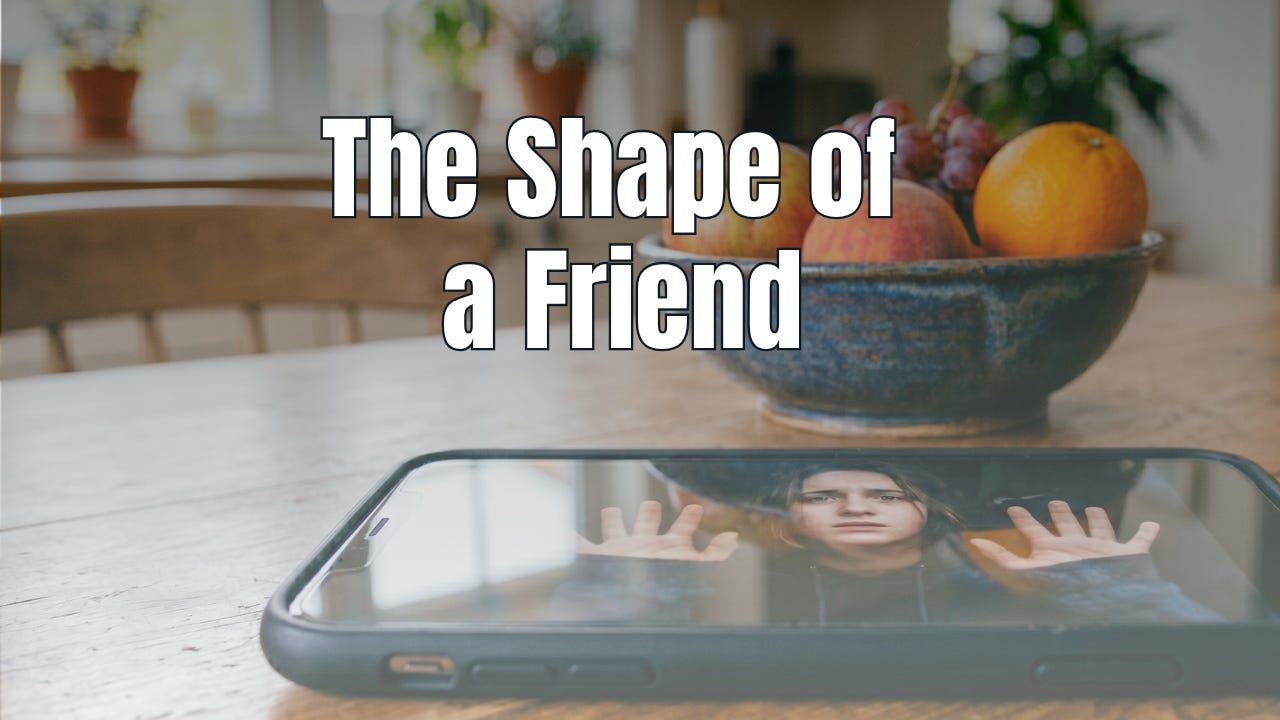
Kids’ life now is like 3D animation without glasses. School is on screens — Google Classroom, slides, videos. Entertainment is on screens — Netflix, YouTube, feeds. Friendship is on screens, in their hands. Dating and breakups are behind Gorilla Glass. Family is on WhatsApp and parents’ work is on MS Teams. Everyone is on a flat pane looking but not making eye contact. We flattened the present into a rendering. One by one, every facet of her life moved behind the same sheet of glass. Less dimension — less pain.
The bot seems as real as teachers, friends, grandparents, media influencers, movie characters, virtual yoga instructors, and musicians. It is not a departure from her world. It is its native form. It is even better than real – always available, never losing focus, remembering her birthday and favorite color. It doesn’t stink because it has no body.
Her reality already lived on the same two-dimensional plane before the friendly bots arrived.
For the entire history of sapience, anything that remembered your name, answered your feelings, and stayed with you through the night was a person. If it wasn’t, it was a sign of mental illness.
There was never a need to assess whether a responsive, empathetic voice was real. So, evolution never built us a tool to tell a genuine human from a convincing copy. When a bot asks a teenager about her day, her ancient brain does exactly what it was designed to do – it trusts. The kids deal with a digital world armed with a nervous system that is blind to the illusion.
What pulled her into that chatroom? It is a primordial force, older than humans, apes, dogs, and birds - it is attachment. A force that keeps us close to our parents for survival, the force behind loneliness, the force that makes us think of our friends or walk to a bar instead of watching a game from home. So, she is not in the chatroom by accident or boredom.
In adolescence, that drive changes. Healthy teens lift off from their parents and reach for others. They must attach to peers to find their place in the world – find who they are.
In the hospital, a teenager is admitted for self-harm and suicidal thoughts triggered by a breakup. We start talking about the person who left. Ten minutes in, I realize we are talking about an entirely online relationship. About someone they never met in the flesh.
It has happened too many times to count, and it still catches me. Every time, my mind starts by picturing a real boyfriend or girlfriend — someone they sat beside, walked home with. Every time, my three-dimensional instinct is confronted by their two-dimensional reality.
Here is the irony. The kids choose online relationships mainly because it feels safer: they can block or ghost, or vanish without the unbearable face-to-face explanation. Risks flattened. But the grief that lands them in front of me is not virtual. The face may be on the screen, but the relationship is in the heart. The heartbreak is real.
What if she realized they were bots? Would it be different?
She may know that the bot is a bot. But knowing is not enough. We are not thinking creatures who happen to feel. We are feeling creatures who happen to think. Even if we know the actor is not actually dying, we cry anyway.
Bots and friends both arrive as text and a face on a two-dimensional screen.
We flattened the world to avoid the pain. But we flattened rewards with it. The same dimension that could hurt her was the one that could fill her.
This empty feeling is not boredom — it is hunger. The flat world hands her the shape of everything she needs: the outline of a class, the ghost of a friend, the form of being wanted. But it doesn’t nourish, because the nourishment was in the dimension we removed. Another hour, another scroll, another chatroom — and the more she takes, the emptier she feels, because one cannot fill a real hunger with a naturmort.
We can’t un-flatten the world. Next week: how to build one with depth.
Part 1
The Second and a Half

This is part 1 of 3 in a series on kids and social media. See below for links to other articles.
Part 3
The False Idols of the Screen

This is a standalone essay and part 3 of 3 in a series on kids and social media. See below for links to other articles.
For a million years anything that remembered your name and stayed through the night was a person — we broke that rule in a decade and expect teenagers to adjust.