

This is a standalone essay and part 3 of 3 in a series on kids and social media. See below for links to other articles.
Every parent is afraid their children are disappearing into the screen. We sacrifice so much for our kids. We want them to be like us, better than us. We get frustrated when they don’t listen because we are scared. I see it clearly in immigrant families. Their sacrifice is still raw; it still hurts. They left their country, language, way of life. And now they watch kids disappear into a blue glow—away from everything they hold dear. Those I meet can’t even find words to describe it.
Parents try to pass down their most important values — discipline, diligence, tradition, national pride. They believe these values have given their lives purpose and meaning. The parents invoke them in hard times, like they would evoke old gods, but the kids do not hear them. To them, these gods sound outdated — gods they do not want to worship.
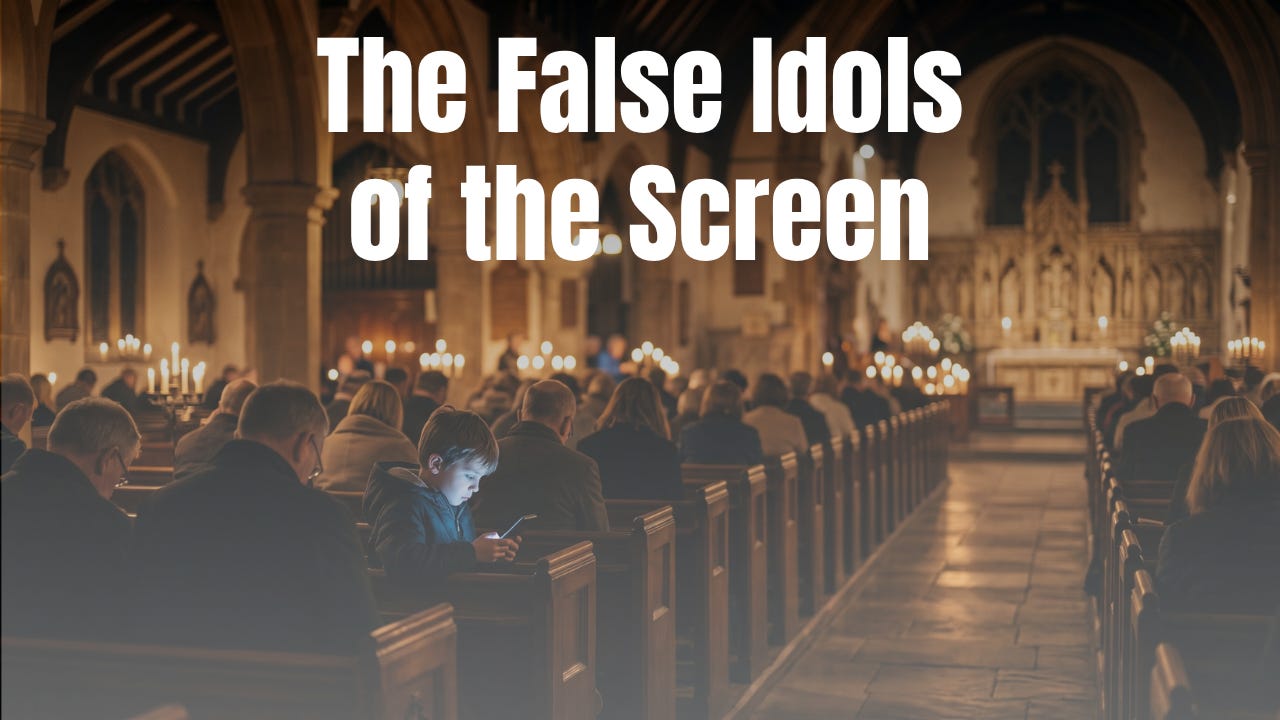
This dynamic creates internal conflict. On the one hand, parents want to protect kids from destroying traditions; on the other, they want kids to enjoy easier, more prosperous lives, have access to technologies just like their friends. Parents are not asking kids to live in the past—only to stay present. But they are losing — torn between handing over the screen and tearing it away. The parents are right about the danger and wrong about the cure.
Sometimes I listen to the kids and feel as if they are at war with their parents. They are like modern crusaders fighting for their gods. But their gods are no more than false idols.
They fight for freedom. They believe infinite entertainment is freedom of choice. The endless scroll, binge-worthy shows, food magically appearing at their door. But look up and they find themselves caged inside basement walls.
They fight for their tribe — their friends. They believe instant messaging gives them the connection they crave. Best friends on the screen look so close they can almost touch. Kids hear them talking, laughing, breathing. Friends are so close that they can see pores on their noses. They just cannot smell them — yet. But let the battery die and BFF disappears, like a mirage.
They fight for mastery of the world. In the game, they are race drivers, flight pilots, and ancient warriors. Immersive surround sound and 3D glasses take them into the middle of the action. The tires squeal, the swords clash against the armour. But take the headset off and it is a parent lecturing them about mess in their room and a garbage bin.
Why does this happen? It is because the kids have a genuine, ancient need to succeed, to be a part of something bigger than they are, to be special. The lure of an easy win is irresistible. But the altar is empty. They feel hungry, but their prayers go unanswered. So, they try harder — another hour, another game. The hunger turns into numbness. Because you cannot satisfy hunger with an Instagram reel.
So the parents, watching their kid drift toward false idols, try to pull them back into the safety of the family.
Obvious solution — “Get off the phone!” Respect your family. Study. Be who we raised you to be. But they get the opposite result. This pressure from outside just hardens kids’ resolve.
It has a clinical name — the tug-of-war. The child holds one end of the rope; you hold the other, and the harder you pull, the harder he pulls, because as long as you are pulling he has something to brace against — and bracing against you becomes his mission, his identity. The way to end a tug-of-war is not to pull harder. It is to gently loosen the grip.
And then what?
The goal is to find ground in something older than us. Believer guards their faith, patriot–their country, parent–their traditions. The clothes are different. The passion is the same. Psychologists call this common thread Self-Determination Theory. This theory has shown that all humans are born with the same drives — the drives that make every baby smile at the parent, every toddler risk climbing stairs, or teenager move into an uncomfortable dorm to find themselves.
Three drives, as real as hunger. The need for autonomy, relatedness, and competence. These are the real gods we all worship, regardless of our religion. Starving them makes us numb and angry. They can only be fully satisfied by real sacrifice.
This is what the parents wanted all along. Diligence and independence served autonomy. National pride and tradition served relatedness. Discipline—competence. The old gods were only a manifestation of the real three. The false idols put on the same clothes. The kid and his parents hunger for the same thing — they only disagree about where to find it.
And so the rope fails. A value truly becomes theirs only when it is chosen freely — which is exactly what external pressure takes away. The harder you pull, the less it belongs to him.
I wish I could give you a simple formula for the right amount of screen time or magic words to bring your kid outside to play. I don’t. The false idols have a real grip on our kids. But I know burning their idols is not a solution. They have to experience the real gods.
They need to feel the steering wheel and elation upon arriving home alive. Being responsible for your own life and the lives of others is not the same as avatars.
The most confusing part is that the screen may actually serve real gods. If a kid is passionately filming herself testing a new hair product, then spending the whole night editing, perfecting it, and posting it, it is not a mirage. Getting likes is relatedness, and editing is competence. Success on TikTok may lead to a financial autonomy better than any degree.
The difference is consumption versus creation. The same phone is an idol when she scrolls and a god when she crafts.
You may hear advice: ask your children what they want, what they care about, what they like. But it often returns nothing. A kid whose heart is already captured by the idol will tell you “I don’t know,” or “I enjoy gaming,” because choosing the counterfeit is easy and satisfying enough.
The rule of thumb is to ask if your kid’s life is getting bigger or smaller. Have they stopped talking to friends and family, staying by themselves in the room 24/7, getting no genuine experiences? Then the false idols are controlling them.
My approach is grounded in Self-Determination Theory. It is to set boundaries with protected space inside to negotiate. My kids can decline my idea — say, playing tennis — but then they owe me a real alternative. And that choice tells the world what they care about. The screens are not on the menu. It is choosing something real when the easy option is fenced off.
We are not perfect, but from one parent to another, I can share. In my own home, the rules are flexible; the expectations are not. Kids can negotiate when they do the dishes, but they have to give a good reason, something real, and they cannot get off the hook completely. I try to listen to what is important to them and help make it happen. But some things are not negotiable — sleep, food, school. Those are fences, and fences are for safety. Skip school and the real gods go hungry. If they are spending time with friends on the screen, their need for relatedness is met. I don’t have to pressure them to be at the dinner table — they’ll come when they get hungry.
Part 1
The Second and a Half

This is part 1 of 3 in a series on kids and social media. See below for links to other articles.
Part 2
The Shape of a Friend

This is a standalone essay and part 2 of 3 in a series on kids and social media. See below for links to other articles.