

Knowing a forest is not the same as walking through the trees.
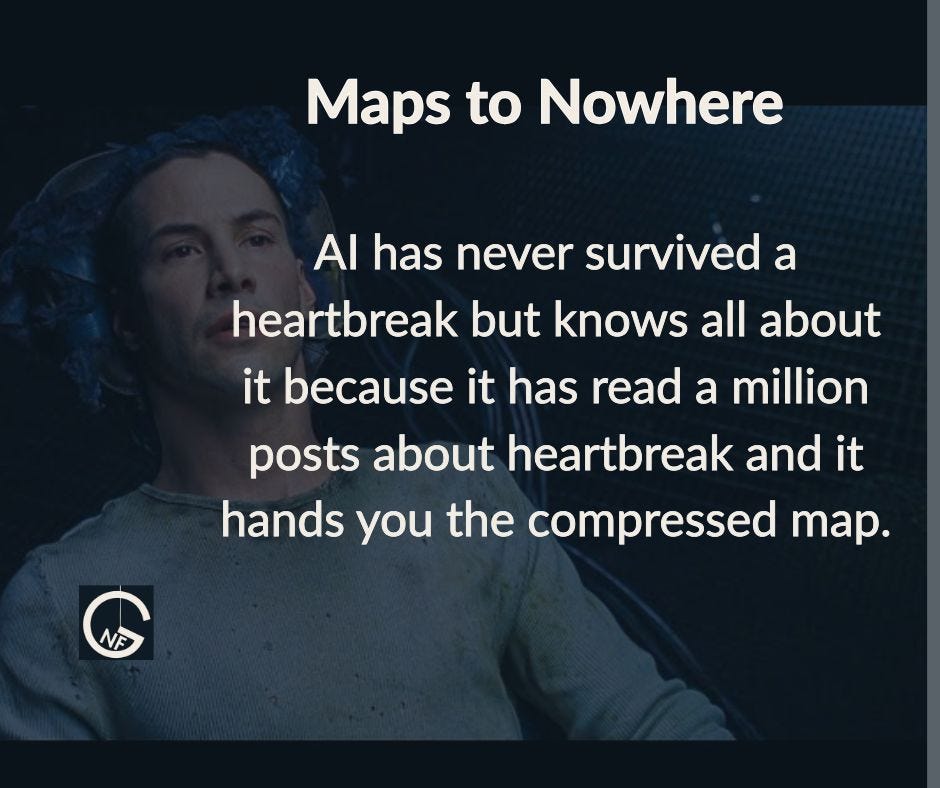
Remember the scene in The Matrix? Neo lies back in a chair, a massive cable jacks into his skull, and a computer uploads a martial arts training program directly into his brain. He opens his eyes, blinks, and says, “I know kung fu.”
No, he doesn’t.
He knows about kung-fu. He got only a map of moves. It is like picking up a map of Toronto and saying you know the city.
What the cable can never upload is the fighter. As I argued in “The Price of Consciousness,” the only interface we have to our own bodies is consciousness — and it is painfully narrow. The body has no other port. There is no back door; each rep has to be processed by our slow consciousness before it is transcribed as a skill.
A fighter is built in the body, not the mind — thousands of reps until the move drops below awareness. Muscle memory is written slowly, against real resistance, one rep at a time. Five seconds do not buy torn muscles, thousands of hours of sweat, and visceral fear of a fist flying toward his jaw.
This is exactly what is happening to our children.
Our brains evolved to crave maps. Last time, I wrote about how we survive the overwhelming, billion-bit flood of raw sensory data by compressing it into categories. We walk the painful, chaotic trail of life, and our brain builds efficient shortcuts. We trade the raw data for a usable model.
Regardless of age, we only process 10 bits per second. It never grows. But the more we accumulate, the more we compress into those 10 bits. We start with one letter per bit, then a word, then a sentence, then a whole category. A toddler sounds out “c-a-t.” A child reads “cat”, the whole word. You read “betrayal” and every betrayal you have survived is packed inside it — the same bit, far denser cargo.
Ability to think in abstract categories is wisdom, but without lived expericence, it is just an empty zip file.
Humans are map-making machines. We crave more maps because it is our biological imperative, evolved over millennia. This craving for more and more maps made social media irresistible. Until recently, we had to scrape our knees, feel the crushing weight of grief — survive the terrain to be rewarded with a map. It short-circuited this process to become the ultimate map-generator.
When a teenager watches a seven-second POV clip of someone diving off a cliff, their brain instantly uploads a map of that experience. They get the thin, safe echo of exhilaration with no physical risk or courage required. They are Neos — being handed the map of the jump that only works in their imagination, not a cliff.
When kids are troubled, instead of making their own maps, they turn to screens. Algorithms immediately hand them a perfect, high-resolution image. A fight with a friend — “toxic relationship,” a lie — “gaslighting,” fear — “trauma response,” feeling awkward — “social anxiety,” sadness — “depression.” Everything is perfectly explained, packaged, and labelled. It feels like wisdom. But it is only a JPEG of someone else’s reality.
Social media is a collection of real people’s individual maps. To create, one needed to walk the terrain. Content creators went to the cliff to film the jump, got their hands dirty to make a recipe video, smelled the smoke to teach a campfire. The person on the screen burnt their fingers, scratched their knees, tore their muscles. The algorithm only picked which experiences to present to a lonely teenager.
Then comes AI and cuts the last thin tie to the ground. AI hands out synthetic maps that are averaged out of millions of videos, texts, and tracks. It generates answers by scraping millions of human experiences, calculating statistical averages and zipping them before serving.
But when you compress millions of maps together, you don’t get a universal map. You get no map at all. You get a mirage — a map of a land that feels incredibly real, but it isn’t.
Our kids are starting to build their foundational identities on these off-the-shelf summaries. They are adopting labels and worldviews before they have experienced them. Having heard it all online, our kids, like Neo, “know” it all. They feel infinitely educated and wise, but they are terrifyingly ignorant and fragile, because their maps were never grounded in the physical resistance of their own lives.
That is why our kids emerge from their bedrooms speaking with the authority of an oracle. Our first impulse is to tell them what is what because we walked the trails and they only downloaded it. And we are partly right — our map was earned. But it is still only a sliver of reality. The terrain is vast; no one gets the whole of it. We need maps, so they were never the problem. The missing trails are. Ours were walked; theirs were downloaded.
Do not argue with the JPEG. Our kids’ feelings are real — that part is their own raw trail — but the downloaded label is not. You will not win by trading labels. Our job as parents is not to hand them our maps. Our job is to reintroduce them to the gravity of reality. We sacrificed friction for safety and fun and let the matrix of resistance decompose.
Taking away the screens is not enough. We must create new physical spaces with real-world friction, encourage awkward face-to-face conversations, and tangible risks where they can fail, hurt, and recover.
They need to sweat. Neo could only fight inside the Matrix but our kids need gravity — the real ground under their feet. The only way to know a forest is to walk through the trees.