

Our cat starts every day on the same trail. Down the stairs along the banister, a turn toward the glass doors, then toward the smell of coffee. The fridge hums to her right. She passes the pantry, turns right, and often finds food.
If it’s empty, she turns back. This time she passes the stairs toward the faint smell of last night’s dinner, feels the hardwood under her paws, passes the scratch left by a chair leg, turns left. This trail sometimes brings her to food, too.
She does not realize that both trails end in the same place. We call it a servery — the pass-through between the kitchen and the dining room, open on both sides. Her first trail reaches it from the kitchen, her second from the dining room. When my wife asks me to bring something from there, she says one word — “Servery.” Even if you had never heard about it before, now you can find it in any house.
Imagine my cat telling another cat where the food is. She would have to describe every sense — what she saw, what she smelled, the floor under her paws, every turn. She has no concept of a room. To her, there is no servery. There are only two trails that sometimes end in food.
I just handed you the map, but it only points to a destination. It does not give you the experience. You have the concept, but not the experience.
This is what our brain does. It compresses raw data into categories, into maps. If I navigated my house like my cat, re-reading every surface and scent and turn every single time, I would have no attention left for writing, or for anything else. Living on raw data is not humanly possible.
We only get access to raw data in flashes. One sense, for a moment, when we happen to pay attention. The rest of the time the brain cuts reality off and labels it instead, lightning fast. “Stone” on the path. “Laughter” down the hall. “Sour” lemon. “Coffee.” We are like a CEO who never touches dollar bills; instead, he reads financial reports.
Compression is the price we pay for consciousness.
My cat has no maps. So, it would never occur to her to renovate the house to shorten her path to food. Every book ever written, every house ever renovated, every plan runs on that compression. We gave up the terrain and got the power to build on it.
Unfortunately, these compressed maps, are incredibly lossy.
Our senses pour more than a billion bits per second into your nervous system. About 11 million bits come from the external senses; the rest come from internal systems. Your conscious mind runs at around 10 bits per second.
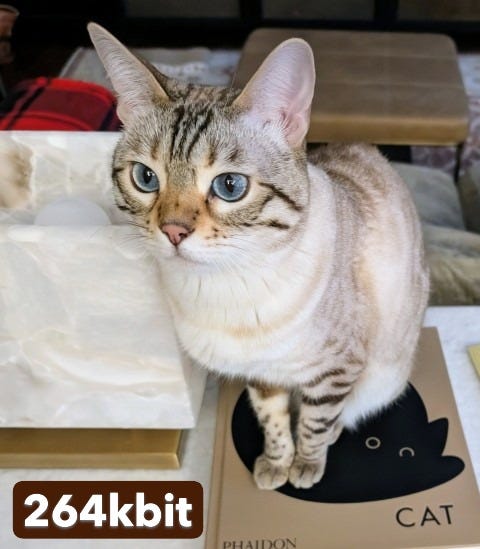
External senses alone generate an equivalent of 230,000 words every second — enough for three books — but consciousness reads just two of them; so 99.9999% of reality is thrown away. And that is only the external senses, mostly the eyes. We live in a heavily compressed simulation all the time. Point a 20-megapixel camera at the world and keep only what your awareness keeps, and you are left with 20 pixels. Not even close enough to recognize the subject. (Picture of our cat above is 264,000 pixels, so 20 pixels is 0.007% of that picture).
Jieyu Zheng and Markus Meister call it “the unbearable slowness of being.”
We also run internal information systems — muscles reporting their length, tendons their tension, gut, blood vessels. Our body makes ten thousand corrections per second to keep us upright and balanced.
Try to do any of it consciously. Balance yourself on a bike, or a snowboard. You fall over because consciousness is far too slow. It takes time for the brain to create a subconscious map.
To be more accurate, the brain doesn’t even get the compressed image. It gets a new rendering. It throws out almost everything, then fills the gaps with imagination — prediction.
To win the evolution game, we have to be efficient, and efficiency runs on prediction — predictions based on maps. The more maps we have, the better we fill the gaps. So, we have a biological imperative to seek new experiences; we find them interesting because each one builds and updates a map.
The world is never real and never enough for us.
Given the choice, would you take the world as raw data? I would not. I would rather live in my own rendering — write, renovate, watch soccer, than experience the full catastrophe living.
We call the lifelong collection of maps wisdom. School hands us a map of mathematics; we throw away the proofs but keep the gist. Same with history, biology, relationships. The wiser we get, the less we touch of the actual thing.
A child arrives with almost no maps. Only the raw input. She lives close to those billion bits, which is why she sees more of the world than you do, but also less efficient.
When your daughter comes apart over a group chat, you check your map for a label. “Just drama”. “Just high school”. “Just a phase”. One word for you; a universe of sensation and feeling for her. Your brain does what it always does when it is swamped — collapses the flood into a single word, half its bandwidth still free. She has no labels yet. She is drowning in the raw signal — blood pressure, heart rate, sweat, tears — with nothing to collapse it into. She argues with you because she sees the evidence. Like the cat, she is reading the raw trail, and from her point of view, she is right and you are not getting it.
In the hospital I see kids in a crisis after a fight with a friend. Parents cannot grasp how a text could do this.
Telling her it’s just drama, just a phase — it is like telling my cat the food is in the servery. A destination with no trail. The word names the experience you have, but she does not.
Her pushback is not aimed at your picture of the world. Do not take it personally. She cannot even see your map, the same way you cannot see her raw trail. Your map explains her meltdown to you. It does not run on her consciousness yet.
You need to walk the trail beside her — name her feeling, so the flood finally has definition, and lend her your own calm, until she can compress the chaos into her own map. But it has to be hers. It is far too easy to slip into “stop it.” She can’t. She does not know how to navigate the path yet.
We get rigid. Our maps have been decades in the making, so we often stop noticing that it is a map at all. The world rarely surprises us now, so we rarely update.
We are born closest to reality and then we lose it. Buddhists spend entire lives trying to get back to the child’s mind but even they cannot fully experience it.
Remember what your map is made of. You built it over decades, out of 0.0001% sliver of reality. Second by second. Your daughter will build her own, out of her own sliver, and it will never match yours. So, create a holding environment. Show her what you’ve built. Just don’t overwrite her operating system.
Reference: Zheng & Meister, “The Unbearable Slowness of Being.” https://pmc.ncbi.nlm.nih.gov/articles/PMC12320479/
Sometimes I prefer "the incredibly slowness " and sometimes prefer it.
Perhaps wisdom is not having the best map, but never forgetting that it is only a map. Reality will always be richer than our concepts, and other people are living in landscapes we cannot fully see.