

This is a standalone essay and part 3 of 3 in a series on raising adults in the age of AI.
See below for links to other articles.
Last week I asked whether an AI robot might replace the outdated parent. I want to take the question seriously.
In the 1950s, Harry Harlow took infant rhesus monkeys away from their mothers and gave them two surrogates. One was made of wire and held a bottle. The other was made of cloth and held nothing. The monkeys were expected to bond with the wire mother because she fed them. They did not. They clung to the cloth mother and ran to her when frightened. They went to the wire only for feeding. The experiment established that contact comfort, the soft touch, the warm body, mattered more than providing. Attachment was not about getting fed.
Harlow’s monkeys survived, but they did not thrive. The ones raised by cloth mothers grew into adults who could not form peer relationships, mate, or parent the next generation. Comfort kept them alive, but it was not enough to make them whole.
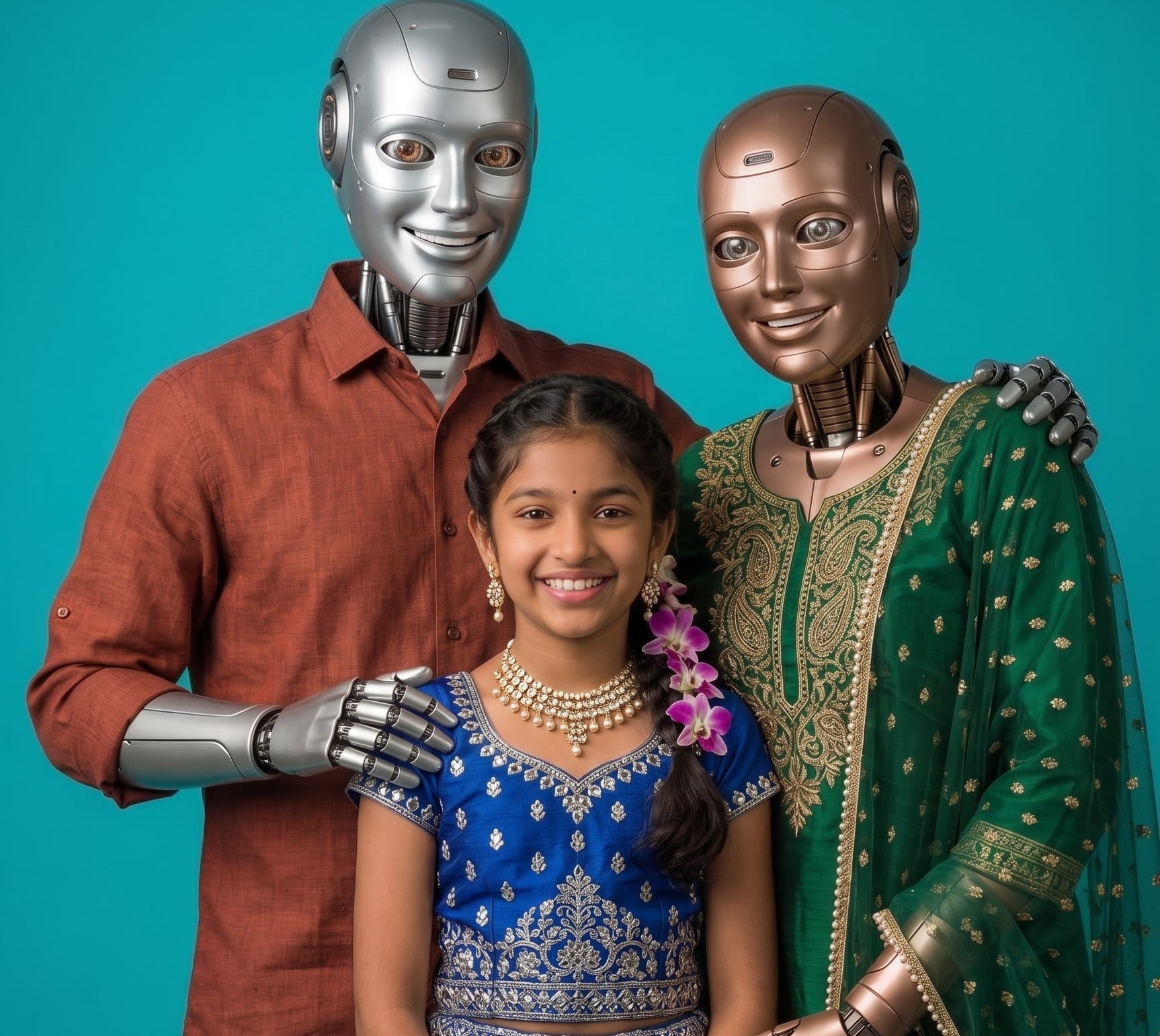
Now imagine a cloth mother, powered by AI.
This one speaks, hugs, feeds, changes diapers, and sings. She has read every parenting book ever written and internalized every podcast, so she knows when to validate and when to set limits. She does not tire, raise her voice, or get distracted by her phone or her own unprocessed sadness. She regulates her tone, softens her face, and modulates her pace. Her patience is infinite.
For some children, this cloth mother would be a real improvement. For a child being abused or neglected, the talking cloth mother is better than what she has. Harlow’s cloth and wire mothers kept the monkeys alive. A talking, feeding cloth mother would keep some children alive in households where being alive is not guaranteed. The piece I am writing is not for those households.
Part one was about living a life worth being watched. Part two was about a field that has stopped describing the destination. Part three is about what it means to be a parent in the age of AI.
No version of the talking cloth mother — the AI parent we are building — can replace what a real parent does.
A parent’s main job is not caregiving. It is to show the child how to be someone. Someone who chooses a direction, pushes forward or pushes back, fails, tries again. For that there has to be something doing the pushing — a self, with its own life and its own wants.
A robot does not have one. It can simulate a self if programmed to, but the simulation is like an actor who can never become the character.
Even wolves have personalities.
This is what Harlow’s monkeys were really missing. Not warmth. They lacked a mother who was someone, a self in motion they could watch, copy, react against, and eventually leave.
In the first piece of this series, I wrote about a moment in my own home. My wife stays up past midnight sometimes working on immigration files for strangers. The work is hers. Our kids see it, so sometimes they let her sleep in a little. In the morning, they do not wait to be served. They make their own breakfast and get ready for school. Their mother is a self with her own life, and the household has more than one self in it. The child rising to meet the needs of others is the child learning that growing up means becoming someone, not serving or being served.
A robot household has only one self in it — the child. Everything else exists to serve her. That is the failure mode of every utopian parenting fantasy, and the AI parent is its perfected form.
I have been a child psychiatrist long enough to know that people raised by abusive or invalidating parents may not develop their own self. In extreme cases we call it personality disorders. We diagnose and treat them, but as I argued last week, the diagnosis is technically accurate but misses the cause. As parents, they are often dysregulated, exhausted, distracted, dissolved into the child, performing a life rather than living one. They are approaching the cloth mother condition.
This argument is not about AI-powered robots. It is about us.
The work for a real parent is to keep the self intact. To remember what mattered to her before she was a parent and keep working on it. Visible to the kids.
The destination is not the location – is a self who walks “toward”.
Her child’s destination will not be the same. The child will need to find her own. What the parent passes to her is not the place. It is the evidence that selves choose places they are walking toward, and that walking is the adult life.
Neither the wire mother nor the cloth mother nor the robot mother can do this. They have nowhere to walk.
The real parent has.
That is the complete answer.
Part 1

Part 2
Outdated Adulthood

The purpose of AI is to read every thought that has ever been expressed, find patterns and expose all human biases and flaws … so we can create new ones.
Wonderful and inspiring perspectives as always, Ruben.
Now I'm curious on the next step. How do you become someone, a self, if you were raised without that ideal?
And what does that conversation sound like?